
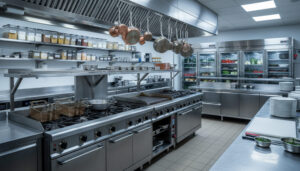
Commercial kitchen refrigeration works in a tough environment. Heat from cooking equipment, grease in the air, blocked clearances, and poor airflow can all make reach-ins, prep tables, walk-ins, and ice machines work harder than they should. Over time, those conditions can lead to warmer box temperatures, longer run times, tripped breakers, compressor stress, and avoidable service calls.
The Condenser Coil Is Your System’s Exhaust Valve
Every refrigeration cycle works by absorbing heat inside the unit and expelling it outside through the condenser coil. When the condenser can efficiently shed heat, the system runs within its design parameters. When it can’t, the compressor has to work harder and longer to accomplish the same cooling, a condition called “high head pressure”.
Busy commercial kitchens can create high head pressure in two common ways:
- The ambient air surrounding the unit is already hot, narrowing the temperature differential the condenser needs to reject heat effectively. A walk-in cooler sitting next to a range or an under-counter reach-in positioned adjacent to a dishwasher is fighting its environment from the moment it switches on.
- Grease-laden kitchen air coats condenser fins over time, reducing airflow through the coil and insulating the fins from the air that does pass through. A condenser coil with even a thin layer of grease buildup can see efficiency losses significant enough to push a system into high head pressure territory, forcing the compressor to cycle longer and run hotter.
What high head pressure actually does:
The compressor must build higher discharge pressure to push refrigerant through a system struggling to reject heat. Over time, this accelerates compressor wear, raises operating temperatures, degrades the lubricating oil that is carried in the refrigerant, and leads to sealed-system failures that are often not repairable, only replaceable.
Airflow Around the Unit Matters as Much as Airflow Through It
Most refrigeration units (reach-ins, undercounters, prep tables) are self-contained systems that need a specific amount of clear space around them to breathe. Manufacturers specify minimum clearances for a reason: condenser air intakes need a source of relatively cool ambient air, and hot discharge air needs somewhere to go.
In real kitchens, these clearances are often compromised. Equipment gets pushed into corners. Reach-ins get slid under shelving. Cardboard boxes accumulate against the back or sides of a unit. The result is hot discharge air recirculating back into the intake, a problem called hot air short-cycling, which causes the system to effectively cool itself in an ever-worsening loop.
Kitchen exhaust systems add another layer of complexity. A powerful exhaust hood can create negative air pressure zones that interfere with the airflow patterns your refrigeration relies on. In some kitchen layouts, the exhaust actually pulls warm air from cooking equipment directly past refrigeration intakes, raising the effective ambient temperature the condenser sees far beyond what the room thermometer would suggest.
Signs Your Kitchen Environment May Be Affecting Refrigeration
| Warm refrigeration equipment | The unit runs constantly but can’t maintain temperature. Often a condenser issue, not a refrigerant issue, check airflow and coil condition first. |
| Tripped breakers | Compressors drawing excess amperage under high head pressure can trip circuits, often misread as electrical problems rather than a refrigeration environment issue. |
| Compressor failure | The end-stage result of chronic high head pressure. Usually accelerated by months of operating in a hot, grease-coated environment without condenser maintenance. |
| Short cycling | The compressor kicks on and off in rapid succession rather than completing a full cooling cycle. Often a symptom of hot air recirculation from blocked clearances. |
What Good Preventive Maintenance (PM) Actually Addresses
A thorough PM visit isn’t just about checking refrigerant levels and wiping down door gaskets. In a commercial kitchen environment, the most impactful maintenance tasks are directly tied to the environmental factors described above: cleaning condenser coils of grease buildup, verifying manufacturer-specified clearances are maintained, and checking that discharge air isn’t being drawn back into intakes.
The frequency of condenser cleaning depends heavily on kitchen volume and cooking style. A high-volume fryer operation can coat condenser fins in a matter of weeks. A lighter prep kitchen may need cleaning quarterly. There’s no universal schedule, the right interval is determined by what the equipment is actually dealing with.
Placement decisions made during a kitchen build-out or equipment shuffle can have lasting consequences. Before adding new cooking equipment near existing refrigeration, or repositioning units to accommodate new workflow, it’s worth thinking through the thermal and airflow implications, ideally before the equipment is in place and plumbed in.
Get the Cause Diagnosed, Not Just the Symptom
If the same unit keeps having problems, the issue may not be the equipment alone. Heat, grease buildup, blocked airflow, poor clearances, or hot discharge air recirculating into the intake can all contribute to repeated failures. A commercial refrigeration technician should look not only at the unit, but also at the kitchen conditions around it.
East Bay Refrigeration works with restaurants and food service operations across the East Bay and understands how kitchen layout, equipment placement, airflow, and maintenance history can affect refrigeration performance. Getting that diagnosis right is what separates a repair that holds from one that buys a few more months before the next breakdown.
Keep Kitchen Conditions From Becoming Refrigeration Problems
Heat, grease, and poor airflow can quietly shorten the life of commercial refrigeration equipment. East Bay Refrigeration provides preventive maintenance, condenser coil cleaning, system inspections, and commercial refrigeration repair for restaurants and food service operations across the East Bay.
Schedule preventive maintenance before small airflow, grease, or temperature problems turn into emergency repairs. Reach out to East Bay Refrigeration online or call us at (510) 940-8917.