If you run a restaurant, grocery store, or any food service operation in the Bay Area, your walk-in cooler or freezer is probably the most important piece of equipment you own.
When it’s running properly, you don’t think about it.
When it’s not, product loss, health code issues, and emergency repair bills get your attention fast.
One of the most common questions we hear is simple:
How often does this equipment actually need to be serviced?
The honest answer: more often than most equipment is inspected—and far less often than the repairs you’ll face if you ignore it..
The Short Answer: Every 3 to 6 Months
For most commercial walk-ins, a professional preventive maintenance visit every 3 to 6 months is a solid baseline.
High-use systems like those in busy kitchens with constant door traffic, heat exposure, or older equipment should be serviced closer to the 3-month range.
That said, the right schedule depends on how your equipment is actually used.
What Affects Your Maintenance Schedule
1. Usage Level
A walk-in fridge or cooler in a high-volume Oakland restaurant sees far more wear than one in a low-traffic setting.
Frequent door openings, heavy loading, and constant cycling all accelerate wear on:
- compressors
- fan motors
- door seals
The harder the unit works, the more attention it needs.
2. Equipment Age
Newer systems tend to run more efficiently, but after 5-7 years, most units begin to require more frequent service as components begin to wear.
You’ll typically see:
- faster coil buildup
- refrigerant drift
- increased electrical wear
If your system is over 10 years old, quarterly maintenance is often a smart move.
3. Environment
Heat, grease, and dust all impact performance.
Units near cooking equipment or in poorly ventilated areas work harder and get dirty faster.
Outdoor compressors face additional challenges in the Bay Area:
- coastal air exposure
- moisture and fog
- seasonal heat spikes inland
All of these accelerate wear.
4. Load and Usage Patterns
Walk-ins that handle frequent temperature swings, like hot products being loaded for cooling, or frequent door openings, experience more stress than systems maintaining a steady load.
More fluctuation means more strain which calls for more frequent maintenance needs.
What Happens During a Maintenance Visit
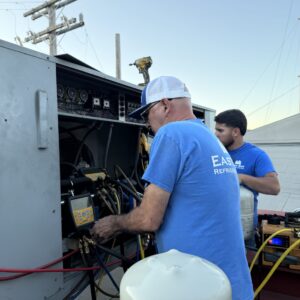
Preventive maintenance is more than a quick check, it’s a full system inspection.
A proper service visit typically includes:
- Checking refrigerant levels and inspecting for leaks
- Cleaning condenser and evaporator coils
- Inspecting door gaskets and hinges
- Testing electrical components and connections
- Verifying defrost cycles and controls
- Inspecting and clearing drain lines
- Confirming temperature accuracy
- Lubricating moving parts
- Checking for early signs of ice buildup or system strain
Each of these directly impacts performance, efficiency, and equipment lifespan.
Skipping them doesn’t mean nothing is happening.
It means problems are developing quietly in the background.
What Happens When Maintenance Gets Skipped
This is where cost starts to build. Small issues don’t stay small in refrigeration systems, they compound.
A dirty condenser coil forces the compressor to work harder.
A harder-working compressor runs hotter and wears out faster.
Field studies and energy program inspections have consistently found that over half of systems in operation are running with incorrect refrigerant charge. Most operators have no idea, because the system is still running, just not efficiently or safely.
An out of range charge results in the compressor overheating AND if the charge is low, which more than half were found to be, less lubricant is carried to the compressor. This shortens the life of the compressor significantly.
That’s how small issues turn into major failures.
A compressor replacement on a walk-in can easily run $2,000 to $5,000+.
A routine maintenance visit that catches the issue early costs a fraction of that.
And Then There’s Product Loss
Equipment failure isn’t just a repair issue, it’s an inventory problem.
If a walk-in fails overnight and the product(s) sits outside safe temperature ranges, the losses in meat, produce and dairy can add up quickly. Also, the need to reorder stock may be urgent.
Often before the business even opens for the day.
This is also where early visibility matters.
Many systems don’t fail all at once, they drift out of performance over time.
Without continuous monitoring, those changes often go unnoticed until it’s too late.
In many cases, the cost of a single product loss event exceeds the cost of routine maintenance for an entire year.
Signs Your Walk-In Needs Attention Now
Even without a maintenance schedule, your system will usually give you warning signs:
- Unusual noise or louder operation
- Temperature fluctuations
- Ice buildup inside the unit
- Excess heat at the compressor
- Worn or damaged door gaskets
- Condensation or water near the unit
- Longer run times or system struggling to maintain temperature
- Unexpected increases in energy use
These issues don’t resolve on their own.
They tend to get worse.
Building a Maintenance Plan That Works
The most effective approach is a consistent, documented maintenance schedule, tailored to how your equipment is actually used.
This removes the guesswork and prevents urgent decision-making.
For most Bay Area businesses:
- Start with twice per year
- Adjust based on performance and usage
Some operations need quarterly service.
Others perform well with semi-annual visits, combined with basic daily checks.
Don’t Overlook Daily Checks
Your staff plays a role too.
Simple daily habits can catch problems early:
- logging temperatures
- checking door seals
- noticing unusual sounds or behavior
These don’t replace professional maintenance but they help bridge the gap between visits.
When “Once a Year” Isn’t Enough
Many systems are serviced once a year, if that. For most commercial environments, that simply isn’t enough to prevent wear, catch early issues, or maintain consistent performance.
—————————————————————
East Bay Refrigeration is based in Hayward and services commercial refrigeration systems across the Bay Area from San Francisco and Oakland to Fremont, San Jose, and the Peninsula.
If you’re unsure when your system was last serviced, or if it’s been a while, we can take a look and give you a clear, honest assessment.
Call East Bay Refrigeration at (510) 940-8917 or schedule service online.